


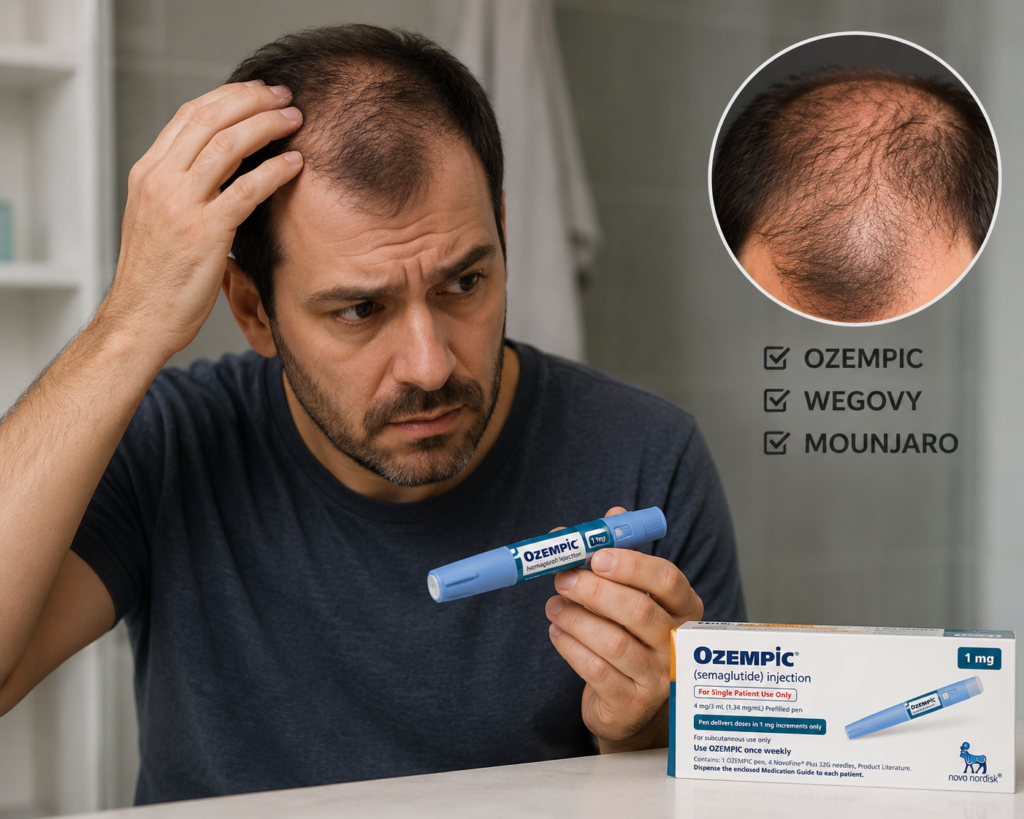
GLP-1 Weight Loss Injections and Hair Transplant procedures are becoming increasingly connected as more patients using medications such as Ozempic, Wegovy, Saxenda and Mounjaro begin noticing hair shedding during rapid weight loss.
Current evidence does not suggest that GLP-1 medications directly damage hair follicles or transplanted grafts. However, rapid weight loss, nutritional deficiencies and metabolic stress may trigger temporary shedding, most commonly telogen effluvium, and may also make underlying androgenetic alopecia more noticeable in genetically predisposed patients.
This blog will help readers understand the cause of hair loss and determine the right timing for hair transplant surgery, which is extremely important for achieving stable and predictable long-term results.
What Are GLP-1 Weight Loss Injections?
GLP-1 receptor agonists are medications designed to mimic the natural glucagon-like peptide-1 hormonein the body. These medications help regulate appetite, slow stomach emptying, improve insulin response and support weight loss.
The most commonly used GLP-1 medications include:
- Ozempic- Semaglutide
- Wegovy- Semaglutide
- Saxenda- Liraglutide
- Mounjaro- Tirzepatide
These treatments are now widely prescribed for obesity management and type 2 diabetes.
GLP-1 Medications and Hair Loss: What Do Scientific Studies Show?
Current scientific literature suggests that the connection between GLP-1 weight loss injections and hair loss is complex and not yet fully understood. A 2025 systematic review evaluating GLP-1 medications and hair loss found conflicting results across different studies.
Some patients developed telogen effluvium after rapid weight loss, while others showed signs of accelerated androgenetic alopecia.
Interestingly, a small number of published cases even reported hair regrowth during GLP-1 treatment.
Large pharmacovigilance databases and FAERS analyses have also identified hair loss after weight loss injections among the reported dermatological side effects associated with GLP-1 medications.
More recent observational studies published in 2026 involving large patient populations reported a trend toward increased hair shedding risk in patients using GLP-1 receptor agonists.
Despite these findings, researchers still have not established a definitive cause-and-effect relationship between GLP-1 medications and hair loss.
Do Ozempic, Wegovy, Saxenda and Mounjaro Cause Hair Loss?
One of the most searched questions online today is whether Ozempic hair loss is real. Similar concerns are now being raised regarding Wegovy hair loss, Mounjaro hair loss and Saxenda hair loss.
Based on current medical literature, GLP-1 medications themselves do not appear to directly attack or damage hair follicles. However, some patients using these medications report noticeable hair shedding several months after beginning treatment.
What Causes Hair Loss After GLP-1 Weight Loss Injections?
Most dermatologists believe the primary trigger is not the GLP-1 medication itself, but rather the physiological stress associated with rapid weight loss. Several factors may contribute to hair loss after weight loss injections:
- Sudden calorie restriction
- Reduced protein intake
- Iron deficiency
- Zinc deficiency
- Vitamin deficiencies
- Rapid metabolic changes
- Physical stress on the body
These factors may disrupt the normal hair growth cycle and push a larger number of hairs into the resting phase prematurely.
Understanding Telogen Effluvium After Weight Loss
In many cases, the hair shedding seen after GLP-1 treatment is consistent with Telogen Effluvium.
Telogen effluvium after weight loss occurs when physical or metabolic stress causes hair follicles to enter the resting phase earlier than normal. A few months later, increased hair shedding becomes noticeable.
This condition typically:
- Begins 2–3 months after the triggering event
- Causes diffuse shedding across the scalp
- Is usually temporary
- Often improves once the body stabilizes
Patients experiencing telogen effluvium after weight loss often panic because the shedding may appear sudden and dramatic. However, in many cases, the condition gradually improves once nutritional deficiencies and metabolic stress are corrected.
Can GLP-1 Medications Accelerate Genetic Hair Loss?
Rapid metabolic changes may sometimes unmask underlying androgenetic alopecia in genetically predisposed patients.
In patients already experiencing male or female pattern hair loss, the shedding triggered by rapid weight loss may make thinning more visible and may accelerate an existing hair loss process.
This is one reason why a proper dermatological evaluation is important. Not every patient experiencing shedding after Ozempic or Mounjaro has the same diagnosis.
Is Hair Loss from Weight Loss Injections Permanent?
In most cases, hair shedding associated with rapid weight loss is temporary. Once the body adapts to metabolic changes and nutritional deficiencies are corrected, hair growth often gradually improves over time.
However, patients with underlying androgenetic alopecia may notice that the shedding accelerates pre-existing hair thinning. This is why early evaluation and proper diagnosis remain extremely important.
How to Reduce Hair Loss While Using GLP-1 Medications
Patients using GLP-1 medications can often reduce the risk of excessive shedding by supporting the body properly during weight loss. Important strategies include:
Maintaining Adequate Protein Intake
Protein deficiency is one of the most common contributors to hair shedding during rapid weight loss.
Monitoring Iron and Zinc Levels
Low iron and zinc levels may worsen shedding and slow hair recovery.
Correcting Vitamin Deficiencies
Vitamin D, B12 and other deficiencies should be evaluated when appropriate.
Avoiding Extremely Rapid Weight Loss
Gradual and controlled weight loss may reduce metabolic stress on hair follicles.
Seeking Dermatological Evaluation
Persistent or severe shedding should always be evaluated professionally to determine the underlying cause.
GLP-1 Weight Loss Injections and Hair Transplant
The relationship between GLP-1 weight loss injections and hair transplant surgery is becoming increasingly important as more patients undergo obesity treatment before considering hair restoration procedures.
The good news is that current scientific evidence does not show that GLP-1 medications directly harm transplanted grafts. There is no evidence suggesting that medications like Ozempic, Wegovy, Saxenda or Mounjaro directly reduce graft survival.
However, hair transplant after weight loss injections requires careful planning. The most important consideration is whether the patient’s body is metabolically stable at the time of surgery.
How GLP-1 Weight Loss Injections May Affect the Hair Transplant Process
Current evidence does not suggest that Ozempic, Wegovy, Saxenda or Mounjaro directly damage transplanted grafts. However, GLP-1 weight loss injections and hair transplant surgery are closely connected when it comes to surgical planning and patient evaluation.
The main concern is not direct graft damage, but whether the scalp and hair loss pattern are stable enough for proper surgical planning. Ongoing rapid weight loss and active hair shedding may temporarily alter hair density, making it more difficult to accurately assess both the recipient and donor areas.
When Is It Safe to Get a Hair Transplant While Using GLP-1 Medications?
In many cases, patients can safely undergo hair transplant surgery while using GLP-1 medications. However, timing plays a critical role in achieving healthy and predictable long-term results.
Many experienced hair transplant surgeons prefer to wait until:
- Weight loss stabilizes
- Active hair shedding slows down
- Nutritional deficiencies are corrected
- The patient reaches a more balanced metabolic state
In patients experiencing telogen effluvium after weight loss or rapid ongoing weight reduction, postponing surgery until the hair loss pattern stabilizes may allow for more accurate graft planning and better donor area management.
Does Ozempic Affect Transplanted Grafts?
One of the biggest concerns among patients is whether Ozempic or other GLP-1 medications can damage newly transplanted grafts.
Current evidence suggests the answer is no. GLP-1 medications do not appear to directly interfere with graft survival, follicle healing or hair growth biology.
However, indirect factors such as inadequate protein intake, nutritional deficiencies and ongoing metabolic stress may influence recovery and hair growth quality. This is why post-operative nutrition becomes extremely important in patients using GLP-1 medications.
Hair Transplant Results While Using GLP-1 Medications
Current evidence suggests that GLP-1 medications do not directly prevent transplanted grafts from growing. In most patients, transplanted follicles can still achieve healthy growth and survival.
The main challenge is often not graft survival itself, but maintaining long-term harmony between transplanted and existing native hair. In patients experiencing ongoing shedding or progressive androgenetic alopecia, surrounding native hairs may continue to thin after surgery, which can affect overall visual density and cosmetic predictability over time.
For this reason, stabilizing active shedding and carefully evaluating future hair loss progression are important for achieving natural and predictable long-term hair transplant results.
The Recovery Process After Hair Transplant While Using GLP-1 Medications
In most patients using GLP-1 medications, the post-operative recovery process is generally normal. Scabbing, redness and healing typically follow the same timeline seen in other hair transplant patients.
However, maintaining adequate nutritional intake during recovery is especially important in patients using GLP-1 injections due to appetite suppression and rapid metabolic changes. Proper nutrition supports wound healing, graft recovery and healthy hair growth during the post-operative period.
Important post-operative considerations include:
- Adequate protein intake
- Proper hydration
- Maintaining balanced nutrition
- Avoiding excessive or very rapid weight loss during recovery
- Following all post-operative care instructions carefully
Some patients may also experience temporary shock loss after surgery, especially if active shedding is already present. In most cases, this is temporary and improves gradually over time.
Supportive Hair Loss Treatment and Tricopat Protocol After GLP-1 Weight Loss Injections
In patients experiencing hair shedding after using GLP-1 receptor agonists, hair loss treatment is not approached as a single-symptom problem. Instead, the process is evaluated in a more comprehensive way, taking into account metabolic status, nutritional balance and the overall hair growth cycle.
At Civas&Akpınar Hair Transplant, patients are thoroughly examined by our dermatology specialists, and a personalized treatment plan is created based on the underlying cause of hair shedding. In many cases, this includes addressing possible telogen effluvium after weight loss, as well as supporting the body’s recovery from rapid metabolic changes.
As part of this approach, the Tricopat protocol is used in our clinic as an important supportive treatment option. Tricopat is designed to help maintain scalp biological balance and support the healthy function of hair follicles, aiming to improve the overall environment for hair growth and recovery.
Depending on the needs of the patient, additional supportive hair loss treatments may also be recommended to enhance results and support long-term hair density stabilization.
Considering a Hair Transplant While Using GLP-1 Medications?
In clinical practice, we have seen an increasing number of patients using GLP-1 medications who are considering hair transplant surgery.
Based on the clinical experience of Dr. Civas and Dr. Ümit Akpınar, and after individual evaluation, our clinic generally recommends stopping GLP-1 injections at least 4-8 weeks before surgery. The main concern is not direct graft damage, but ongoing telogen effluvium and unstable shedding during rapid weight loss, which may temporarily affect the donor area and make planning less predictable.
In most cases, patients are advised to restart GLP-1 medications around 6 months after hair transplant surgery, once early growth becomes more visible. This helps ensure that healing and graft development occur under stable conditions, and allows clearer evaluation of transplant results without overlapping medication-related shedding effects.
If you are using GLP-1 medications and are considering a hair transplant, you can contact our clinic for a FREE personalized assessment and treatment plan..
FAQ: GLP-1 Weight Loss Injections and Hair Transplant
Q: Do GLP-1 weight loss injections cause hair loss?
A: GLP-1 weight loss injections such as Ozempic, Wegovy, Saxenda and Mounjaro do not directly cause hair loss. However, rapid weight loss, reduced calorie intake, and nutritional deficiencies may trigger temporary shedding known as telogen effluvium.
Q: What type of hair loss is most common after weight loss injections?
A: The most common type is Telogen Effluvium, a temporary condition where hair follicles shift into the resting phase due to physical or metabolic stress.
Q: When does hair loss start after using GLP-1 medications?
A: Hair loss after weight loss injections typically starts 2-3 months after rapid weight reduction begins, especially if there are nutritional deficiencies or significant metabolic changes.
Q: Can you have a hair transplant while using Ozempic or Mounjaro?
A: Yes, a hair transplant can be performed while using GLP-1 medications. However, if active shedding or rapid weight loss is ongoing, surgeons may recommend waiting until the body reaches a more stable metabolic phase.
Q: Do GLP-1 medications affect hair transplant graft survival?
A: Current evidence shows no direct effect of GLP-1 medications on graft survival. However, factors such as nutrition, protein intake, and overall health can indirectly influence healing and hair growth outcomes.
Q: When is the best time for a hair transplant if you are using weight loss injections?
A: The best time for a hair transplant is when weight loss has stabilized, active shedding has slowed, and nutritional status is balanced. In many cases, waiting 3-6 months after stabilization improves results.
Q: Do hair grow back after GLP-1 medication-related hair loss?
A: Hair loss seen after GLP-1 medications such as Ozempic, Wegovy, Saxenda and Mounjaro can be temporary in many cases. Once the body regains metabolic balance, hair regrowth is often possible. However, the underlying cause of shedding must be properly evaluated, and patients are advised to consult a dermatologist for an accurate diagnosis.
Q: Are GLP-1 weight loss injections a contraindication for hair transplant?
A: No. GLP-1 weight loss injections are not a direct contraindication for hair transplantation. However, if active hair shedding is present, postponing the procedure may lead to more stable and predictable results.
Q: Do all patients using GLP-1 medications experience hair loss?
A: No. Not every patient using GLP-1 medications experiences hair loss. The risk depends on individual metabolism, genetic predisposition, nutritional status, and the speed of weight loss.
Q: Who is at higher risk of hair loss while using GLP-1 medications?
A: The risk of hair shedding is higher in patients who: lose weight rapidly, have nutritional deficiencies or have a genetic tendency to androgenetic alopecia.