


Androgenetic Alopecia is one of the most common aesthetic concerns among men, and Clascoterone 5% for male pattern hair loss has recently emerged as a promising new treatment.
Clascoterone 5% solution works through a targeted mechanism by locally blocking androgen activity in the scalp rather than affecting hormones throughout the body. With encouraging results demonstrated in Phase 3 clinical trials, it may represent one of the most important developments in hair loss treatment in decades if regulatory approval is completed.
In this blog, we will explain how Clascoterone works, review the available clinical evidence, discuss its safety profile and potential side effects, and clarify who may benefit most from this treatment and what results patients can realistically expect..
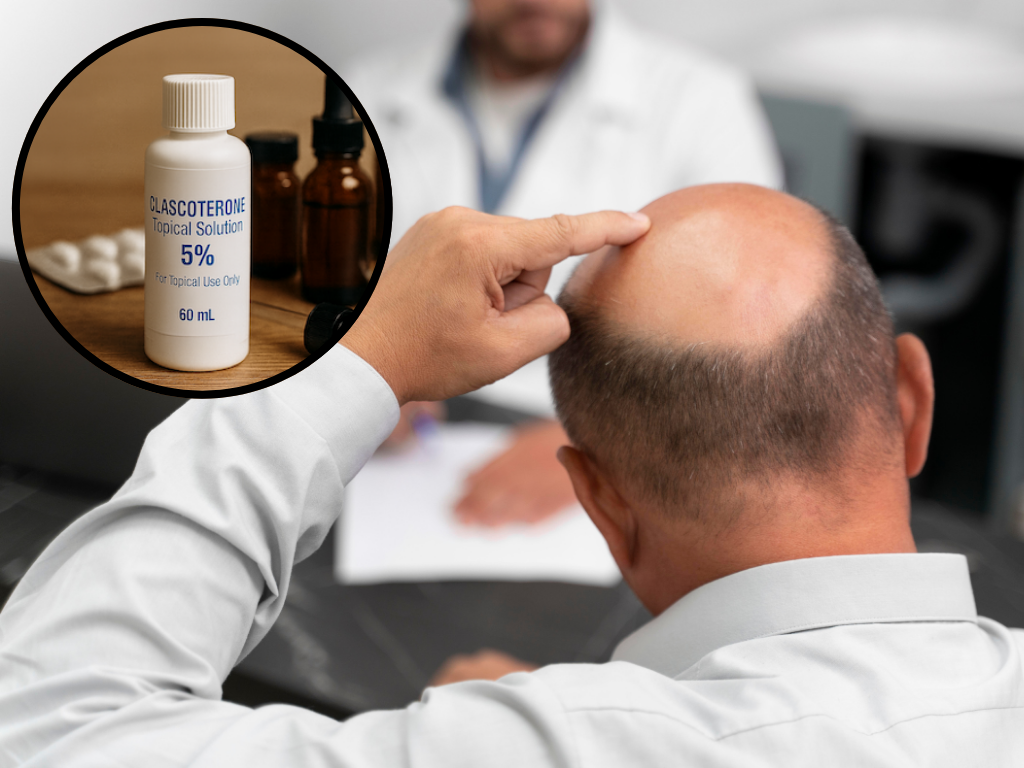
What Is Male Pattern Hair Loss (Androgenetic Alopecia)?
Male pattern hair loss, medically known as androgenetic alopecia, occurs when hair follicles are genetically sensitive to the hormone DHT (dihydrotestosterone). When DHT binds to androgen receptors within the follicle, it gradually disrupts the normal hair growth cycle, leading to:
- Shrinkage of hair follicles
- Progressive thinning of hair strands
- Shortening of the growth (anagen) phase
This process, called follicular miniaturization, causes hairs to become finer and shorter over time and can eventually result in permanent hair loss if untreated. Because DHT activity plays a central role, therapies such as topical anti-androgen treatments, including Clascoterone, aim to directly target this mechanism at the scalp level.
Limitations of Current Hair Loss Treatments
The most commonly used treatments for male pattern hair loss include:
Minoxidil: Stimulates hair follicles and prolongs the growth phase. However, it does not address the underlying hormonal cause of androgenetic alopecia.
Finasteride and Dutasteride: Reduce DHT production throughout the body. Because they act systemically, some patients may experience unwanted side effects, leading many to search for a finasteride alternative.
Low-level laser therapy (LLLT): May improve cellular activity and support hair growth in some patients, but its effects are generally modest and it does not directly block androgen activity at the follicle.
For this reason, interest has grown in more localized approaches that target DHT activity directly at the scalp.
What Is Clascoterone 5% Solution?
Clascoterone 5% is a topical anti-androgen that blocks androgen (DHT) receptors directly in the skin and scalp rather than lowering hormone levels throughout the body. It is already used in dermatology as a treatment for hormonal acne, and is now being developed for male pattern hair loss. By reducing the effect of DHT on hair follicles, it aims to slow follicular miniaturization and help preserve hair density while minimizing systemic side effects associated with oral medications.
How Does Clascoterone 5% Solution Work?
Clascoterone 5% acts as a topical anti-androgen by locally blocking androgen receptors within the hair follicle. Instead of lowering hormone levels throughout the body, it interferes with DHT activity directly at the scalp:
- DHT production is not suppressed systemically
- The effect remains limited to the area of application
- The risk of systemic hormonal side effects is minimal
Because its action is localized, this treatment may be particularly appealing for patients who prefer to avoid oral medications or are concerned about potential systemic side effects while still targeting the underlying hormonal mechanism of androgenetic alopecia.
Clascoterone 5% Solution: Phase 3 Clinical Trials (SCALP-1 and SCALP-2)
In the Phase 3 SCALP-1 and SCALP-2 studies conducted in the United States and Europe, more than 1,400 men with androgenetic alopecia were evaluated to assess Clascoterone 5% for male pattern hair loss.
For the first 6 months, participants used the assigned treatment in a double-blind setting, meaning neither the patients nor the investigators knew who received the active medication. This was followed by an additional 6-month follow-up period, allowing both short- and longer-term outcomes of Clascoterone 5% solution to be analyzed.
The evaluation included not only physician-measured parameters but also patient-reported observations and satisfaction. In this way, the effectiveness of Clascoterone for Androgenetic Alopecia was assessed comprehensively using both objective clinical data and real-world user experience.
What Do The Clinical Results Of Clascoterone 5% For Male Pattern Hair Loss Show?
Phase 3 data showed that, compared to a placebo, the application of Clascoterone 5% led to:
- Increased hair density
- A higher number of terminal hairs
- Improved hair thickness
These outcomes indicate measurable clinical improvement rather than only theoretical benefit, supporting its potential role as a targeted treatment for androgenetic alopecia.
Clascoterone 5% Solution: Patient Satisfaction and Quality of Life
In addition to objective measurements, the clinical trials also evaluated patient-reported outcomes. Among patients using Clascoterone 5% for male pattern hair loss, participants reported:
- Increased satisfaction with hair appearance
- A perceived slowing of hair loss progression
- Greater motivation to continue treatment
The consistency between patient feedback and clinical findings suggests meaningful real-world benefit and supports long-term adherence, an important factor in managing Androgenetic Alopecia.
Is Clascoterone 5% Effective for Male Pattern Hair Loss?
Current clinical evidence suggests that Clascoterone 5% can produce measurable improvements in hair density, thickness, and terminal hair count compared with placebo. The treatment appears most beneficial in early to moderate Androgenetic Alopecia, where reducing follicle exposure to DHT can help slow progression and support partial regrowth.
Results are generally gradual and may be more modest than systemic therapies in some patients, but its targeted mechanism and favorable safety profile make it a promising option, particularly for patients seeking a topical treatment or a finasteride alternative. It may also be used alongside other therapies such as Minoxidil as part of a combination approach.
Is Clascoterone 5% Safe?
A common question regarding this new treatment is whether Clascoterone 5% is safe for patients.
Based on current clinical data, the safety data for this new topical antiandrogen are highly favorable:
- The rate of side effects is similar to placebo
- No systemic hormonal effects have been observed
- Systemic absorption is minimal
Because its action remains localized to the scalp, this topical anti-androgen may be suitable for long-term use in patients seeking treatment for Androgenetic Alopecia. As with all Phase 3 trials, long-term real-world data will be crucial to fully confirm this positive safety profile.
What Are the Side Effects of Clascoterone 5%?
Clinical studies evaluating Clascoterone 5% show that the treatment is generally well tolerated. Because it acts locally at the scalp rather than systemically, most reported side effects are mild and limited to the area of application. Reported side effects may include:
- Mild scalp redness
- Itching or a burning sensation at the application site
- Dryness or irritation of the scalp
In clinical trials, the overall rate of adverse effects was similar to placebo. Importantly, no clinically meaningful systemic hormonal effects were detected, which is consistent with the medication’s minimal systemic absorption.
Some patients may notice temporary changes in shedding early in treatment, although this has not been consistently observed in studies.
Who Can Use Clascoterone 5% Solution?
Once regulatory approval is completed, Clascoterone 5% may be particularly suitable for:
- Patients with early to moderate Androgenetic Alopecia
- Patients who prefer to avoid oral medications
- Those concerned about systemic side effects
- Patients who have not achieved sufficient benefit from existing treatments such as Finasteride, Minoxidil or LLLT Therapy
Depending on the clinical situation, it may be used either as an alternative to systemic therapy or as a complementary treatment alongside other existing hair loss therapies.
Important Considerations During Treatment
For optimal outcomes with Clascoterone 5%, several practical points should be kept in mind:
- Consistent, regular application is essential for effectiveness
- At least 6 months of use is usually required to properly evaluate response
- Treatment should be planned and monitored under the supervision of a dermatologist
As with most therapies for Androgenetic Alopecia, interruption or irregular use may reduce the likelihood of visible improvement.
Clascoterone 5% and Hair Transplant: Can It Help Maintain Results?
Medical hair loss therapies and hair transplantation are complementary approaches rather than alternatives. While hair transplantation restores density in areas where follicles are already lost, ongoing medical treatments such as Finasteride or Minoxidil help stabilize surrounding native hairs and prevent further hair loss.
In the future, Clascoterone 5% may potentially be incorporated into post-transplant care as part of a more comprehensive treatment strategy. As a targeted topical anti-androgen, it may help preserve non-transplanted hairs and contribute to more stable long-term hair transplant results when used under physician guidance.
Clascoterone 5% for Hair Loss: Expert Advice from the Civas&Akpınar Specialists
According to our dermatology experts at Civas&Akpınar, Clascoterone 5% could be a targeted and patient-friendly treatment approach for male pattern hair loss. Current Phase 3 clinical data suggest meaningful efficacy with a favorable safety profile, making it one of the most promising topical anti-androgen therapies under development.
However, while the available evidence is encouraging and we hope Clascoterone 5% will become clinically available in the near future, patients should continue using established, approved medical treatments that are currently available and supported by long-term data.
Each case of Androgenetic Alopecia is unique, and the right treatment depends on your hair loss stage, goals, and medical history. To learn which hair loss treatment options are most suitable for you, schedule a personalized assessment with the dermatology experts at Civas&Akpınar Hair Transplant Clinic in Turkey..
FAQs About Clascoterone 5% For Male Pattern Hair Loss
Q: Is Clascoterone 5% more effective than Finasteride?
A: No direct head-to-head studies currently prove that Clascoterone 5% is more effective than finasteride. Early clinical trials show promising hair growth results, but finasteride remains the most established medical treatment for androgenetic alopecia. Clascoterone may become an alternative for patients who cannot tolerate systemic therapy.
Q: Which is better: Clascoterone or Minoxidil?
A: They work differently rather than competitively. Minoxidil stimulates hair growth cycles, while Clascoterone targets androgen receptors locally. In practice, they may be complementary and could potentially be used together to improve overall outcomes.
Q: When will Clascoterone 5% be available?
A: Clascoterone 5% for hair loss is still under clinical investigation and has not yet received widespread regulatory approval for Androgenetic Alopecia. Availability depends on ongoing trial results and regulatory review timelines.
Q: How long does it take to see results?
A: Based on clinical trial patterns, visible improvement may begin after approximately 4-6 months of consistent use, with fuller assessment typically around 9-12 months, similar to other medical hair loss therapies.
Q: Is Clascoterone 5% safer than oral anti-androgens?
A: Clascoterone acts locally in the scalp and shows minimal systemic absorption in clinical studies. This suggests a lower risk of systemic side effects compared with oral anti-androgens, although long-term real-world safety data are still limited.
Q: Can Clascoterone 5% be combined with other treatments?
A: Yes. In theory, clascoterone may be combined with treatments such as minoxidil or hair transplantation as part of a multimodal approach, depending on the doctor’s evaluation and individual patient needs.
Q: Could Clascoterone replace hair transplants?
A: In clinical practice, treatments that only block receptors typically stabilize hair more than regrow dense coverage. Therefore, Clascoterone will likely function closer to a progression-control therapy rather than a replacement for hair transplantation in advanced stages.