


The relationship between hair transplant and keloid scars is an important consideration for anyone with a history of abnormal scarring who is considering hair restoration.
Although keloids are an uncommon complication of hair transplant surgery, patients who are prone to developing them often wonder whether they are suitable candidates for the procedure.
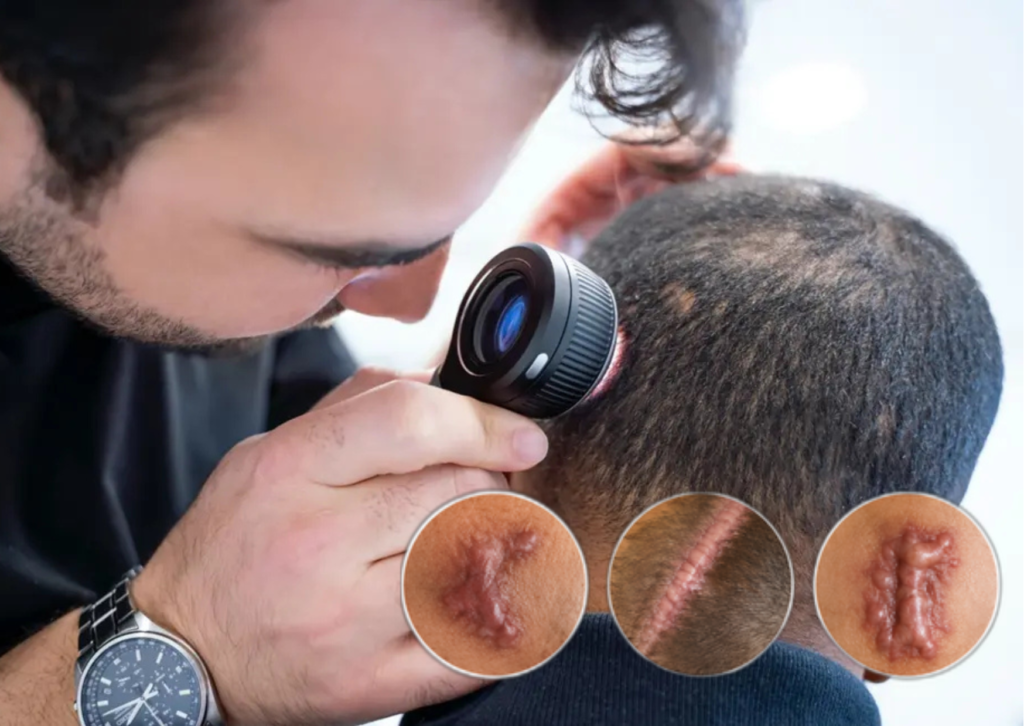
A keloid is a raised scar caused by an overproduction of collagen during the healing process. Since a hair transplant involves making tiny incisions in the scalp, understanding a patient’s tendency to form keloids is an important part of preoperative assessment.
However, having a history of keloids does not automatically rule out hair transplantation. Instead, candidacy depends on several factors, including your medical history, previous scarring, and a thorough evaluation by an experienced dermatologist.
In this guide, the expert dermatologists at Civas&Akpınar explain who may be a suitable candidate, what factors influence the risk of keloid formation, whether different hair transplant techniques affect that risk, and what you should know before deciding to undergo the procedure.
What Are Keloid Scars?
A keloid is an abnormal, excessive accumulation of scar tissue that develops after skin injury or surgery when the normal wound-healing process continues uncontrollably.
During normal wound healing, the body repairs damaged tissue and gradually decreases collagen production as the scar matures.
In keloid formation, however, this process is disrupted. Cells known as fibroblasts remain overly active, producing excessive amounts of collagen that cause the scar tissue to continue growing.
Unlike normal scars, which gradually flatten and fade over time, keloids continue to grow beyond the boundaries of the original injury, forming raised, firm, and often shiny scar tissue.
- Keloids can develop after any injury to the skin, including surgical incisions, cuts, burns, acne, vaccinations, piercings, and even minor trauma.
- They may appear weeks or months after the skin has healed and, in some cases, continue to enlarge over time.
- While they are usually harmless, keloids can cause itching, tenderness, discomfort, and cosmetic concerns.
- They rarely regress or disappear spontaneously.
- Keloids most commonly develop on the chest, shoulders, back, neck, and earlobes.
- Keloid formation on the scalp is relatively rare.
Keloids are often confused with hypertrophic scars, but the two are not the same. Hypertrophic scars remain confined to the original wound and may improve naturally over time, whereas keloids extend beyond the wound edges and are less likely to regress without treatment.
Keloid Scars vs. Hypertrophic Scars: What’s the Difference?
Although keloids and hypertrophic scars are both caused by an excessive healing response, they are distinct types of scars with different characteristics. Recognizing the differences is important, as they can influence how dermatologists assess the potential risk of abnormal scarring before a hair transplant.
| Feature | Keloid Scarring | Hypertrophic Scarring |
| Growth Pattern | Extend beyond the boundaries of the original wound. | Remain confined to the original wound. |
| Appearance | Raised, firm, shiny, and often irregular in shape. | Raised and thick but usually follow the shape of the original injury. |
| Cause | Excessive collagen production with uncontrolled scar growth. | Increased collagen production during normal wound healing. |
| Time of Development | May develop months or even years after the original skin injury and can continue growing over time. | Typically develop within weeks of injury and stabilize over time. |
| Natural Course | Rarely regress without treatment and may continue growing. | Often flatten and improve gradually over months or years. |
| Common Symptoms | Itching, tenderness, pain, and cosmetic concerns. | May be itchy or uncomfortable initially but usually become less symptomatic over time. |
| Likelihood of Recurrence | High, even after treatment or surgical removal. | Lower than keloids, especially when appropriately managed. |
| Implication for Hair Transplant | Requires careful risk assessment before surgery. | Generally poses less concern, though individual evaluation is still recommended. |
Who Is At Risk of Developing Keloid Scars?
Although anyone can develop keloid scarring, certain factors increase the likelihood of abnormal scar formation. Having one or more of these risk factors does not mean you will definitely develop a keloid, but it does warrant careful evaluation before undergoing any surgical procedure, including a hair transplant.
- Family history: A family history of keloids may indicate a genetic predisposition to abnormal scar formation.
- Previous keloid scars: A personal history of keloids is one of the strongest predictors of developing another keloid after future skin injuries or surgery.
- Darker skin tones: Keloids are more common in individuals with Fitzpatrick skin types IV to VI, although they can occur in people of all skin types.
- Age: Keloids most frequently develop between the ages of 10 and 30 years, when the skin’s healing response is more active.
- Body location: Areas such as the chest, shoulders, upper back, jawline, and earlobes are more prone to keloid formation. The scalp is generally considered a lower-risk site.
- Prolonged inflammation or delayed wound healing: Infection, excessive wound tension, or delayed healing may increase the risk of abnormal scar formation in susceptible patients.
- Abnormal wound-healing response: Some patients produce excessive collagen during the healing process due to genetic, hormonal, and immune-related factors, making them more prone to developing keloids.
- Repeated skin trauma: Frequent injury to the same area, including repeated surgeries, piercings, or chronic irritation, may increase the likelihood of keloid formation.
Are People with Darker Skin More Prone to Keloids?
Yes. Although they can develop in people of any skin tone or ethnic background, keloids are significantly more common in people with darker skin, particularly those with Fitzpatrick skin types IV-VI.
Current research suggests that genetic factors play the most important role, influencing how the skin responds to injury and regulates collagen production during the healing process.
However, it is important to remember that having darker skin does not mean you will develop keloids, nor does it automatically make you not suitable for a hair transplant.
Can Patients Prone to Keloids Get a Hair Transplant?
Being prone to keloids does not automatically disqualify you from undergoing a hair transplant. Whether you are a suitable candidate depends on your individual risk profile, the severity of any previous keloids, and a comprehensive evaluation by an experienced dermatologist.
One of the most important factors is your personal history of keloid formation. Patients who have developed large or multiple keloids after previous surgeries or skin injuries may have a higher risk of abnormal scarring following a hair transplant.
In contrast, patients with no history of keloids or those whose previous scars healed normally, may be suitable candidates even if they have other risk factors.
The location of previous keloids is also important. A keloid that developed after an ear piercing or chest surgery does not necessarily mean the scalp will respond in the same way.
Because the scalp is generally considered a lower-risk area for keloid formation, dermatologists evaluate each patient individually rather than applying a one-size-fits-all approach.
If there is significant concern that a hair transplant could result in problematic scarring, your dermatologist may recommend postponing surgery or considering alternative treatment options.
Key Takeaway:
A history of keloids is not an absolute contraindication to hair transplantation. The safest approach is an individualized assessment by a dermatologist experienced in both hair restoration and scar management.
Can a Hair Transplant Cause Keloids?
A hair transplant involves making thousands of tiny incisions in the scalp, meaning there is always some degree of wound healing. In genetically predisposed patients, any surgical procedure has the potential to trigger keloid formation.
However, keloids after hair transplant surgery are rare, particularly when the procedure is performed on carefully selected patients by experienced surgeons.
Proper surgical planning, meticulous technique, and appropriate postoperative care can all help minimize the risk of abnormal scarring.
Key Takeaway:
While a hair transplant can theoretically cause keloids in susceptible patients, the overall risk is low, and careful patient selection is the most important factor in reducing that risk.
FUE vs FUT: Which Hair Transplant Technique Is Best for Patients Prone to Keloids?
When hair transplantation is considered for a patient at increased risk of abnormal scarring such as keloids, FUE (Follicular Unit Extraction) may be favored over FUT (Follicular Unit Transplantation) because it avoids the long linear incision associated with strip harvesting.
- During FUE, individual follicular units are extracted using small punches, typically approximately 0.6-1.0 mm in diameter.
- In contrast, FUT involves removing a strip of hair-bearing scalp, which results in a linear surgical scar.
Because FUE produces multiple small wounds rather than one continuous linear FUT excision, the resulting scars are typically smaller and less noticeable. This may also reduce the likelihood of problematic scar formation, including hypertrophic scars and keloids.
However, no hair transplant technique can completely eliminate the risk of keloid formation.
How Do Dermatologists Assess Your Suitability For Hair Transplantation?
No two patients have the same risk of developing keloids. Before recommending a hair transplant, an experienced dermatologist will perform a comprehensive evaluation to determine whether the procedure can be carried out safely.
This assessment typically includes:
- Your medical history: Including any previous keloids, hypertrophic scars, or abnormal wound healing.
- Family history: Whether close relatives have developed keloids or excessive scarring.
- Previous surgical scars: Examining how your skin has healed after past surgeries, injuries, piercings, or other procedures.
- Scalp examination: Assessing the health of your scalp, skin quality, and any underlying dermatological conditions.
- Risk–benefit analysis: Determining whether the expected benefits of surgery outweigh the potential risk of keloid formation.
What Increases the Risk of Keloids After Hair Transplant Surgery?
Although keloids after hair transplant surgery are uncommon, certain factors may increase the likelihood of abnormal scar formation in susceptible patients. In addition to a patient’s natural predisposition, the way the skin heals after surgery plays an important role in the final outcome.
Several factors may increase the risks of keloids after hair transplant:
- A personal history of keloids: Previous keloid formation remains the strongest predictor of developing another keloid after surgery.
- Healing complications: Infection, prolonged inflammation, or delayed wound healing can disrupt the normal healing process and increase the risk of excessive scar formation.
- Excessive wound tension: Although FUE creates very small wounds, unnecessary tension or trauma to healing tissues may contribute to abnormal scarring.
- Poor postoperative care: Not following your surgeon’s aftercare instructions may increase the risk of complications that affect wound healing.
- Surgical technique: Careful graft handling, precise incisions, and minimizing unnecessary trauma to the scalp all help promote healthy healing.
Fortunately, many of these factors can be minimized through careful surgical planning, meticulous technique, and appropriate postoperative care. This is why choosing an experienced hair transplant surgeon and following all aftercare instructions are essential, particularly for patients with a history of abnormal scarring.
How Can the Risk of Keloid Formation Be Reduced?
Although it is impossible to eliminate the risk of keloids after hair transplant completely, several measures can help reduce the likelihood of keloid scarring in patients undergoing hair transplant surgery.
- Careful patient selection: The first and most important step is identifying whether a patient is a suitable candidate. A detailed medical history and dermatological evaluation help determine the risk of keloid formation before surgery.
- Meticulous surgical technique: Gentle tissue handling, precise incisions, and minimizing unnecessary trauma to the scalp promote healthy wound healing and reduce the risk of excessive scar formation.
- Appropriate graft density: Placing grafts at an appropriate density helps preserve the scalp’s blood supply and avoids placing unnecessary stress on the healing tissue.
- Preventing infection: Keeping the scalp clean and following sterile surgical protocols reduces the risk of infection, which can prolong inflammation and interfere with normal wound healing.
- Following postoperative instructions: Adhering to your surgeon’s aftercare recommendations, including proper washing techniques, avoiding trauma to the scalp, and attending follow-up appointments, supports optimal healing.
- Early management of abnormal scarring: If signs of excessive scar formation appear during recovery, early intervention by a dermatologist may help prevent the scar from progressing.
What Happens If You Develop Keloids After Hair Transplant?
Although keloids after hair transplant surgery are uncommon, early diagnosis and treatment are important if abnormal scar formation develops. While no single treatment works for every patient, several effective options can help reduce the size of keloid scars, relieve symptoms, and improve their appearance.
Treatment may include:
- Corticosteroid injections: Often considered the first-line treatment, steroid injections can help flatten keloids, reduce inflammation, and relieve symptoms such as itching or tenderness.
- Silicone gel or silicone sheets: These are commonly used to improve scar hydration and may help soften and flatten early keloids when used consistently.
- Laser therapy: Certain lasers can reduce redness, improve scar texture, and, in some cases, help flatten the scar when combined with other treatments.
- Cryotherapy: Freezing the keloid with liquid nitrogen may be effective for smaller lesions, although multiple treatment sessions are often required.
- Surgical removal: Excision alone is generally not recommended, as keloids have a high recurrence rate after surgery. If removal is necessary, it is usually combined with additional therapies, such as corticosteroid injections or radiation therapy, to reduce the risk of recurrence.
The most appropriate treatment depends on the size, location, and severity of the keloid, as well as your medical history. Early assessment by a dermatologist is essential, as treatment is generally more effective before the scar becomes larger or more established.
Hair Transplant and Keloid Scars: When Is Surgery Not Recommended?
Although many patients with a history of keloids may still be suitable candidates for hair transplant surgery, there are situations where the procedure should be postponed or avoided.
These include:
- A history of multiple or severe keloids: Patients who have developed large or recurrent keloids after previous surgeries or skin injuries may have a significantly higher risk of abnormal scarring.
- Active scalp disease: Conditions such as active infections, inflammatory scalp disorders, or uncontrolled scarring alopecia should be treated and stabilized before considering hair transplant surgery.
- Uncontrolled medical conditions: Certain medical conditions that impair wound healing or increase the risk of surgical complications should be appropriately managed before undergoing the procedure.
- Unrealistic expectations: Patients should understand both the potential benefits and limitations of hair transplantation, including the possibility of scarring and the variability of individual results.
- When the risks outweigh the benefits: If a dermatologist determines that the likelihood of developing significant complications is greater than the expected benefit of surgery, alternative treatment options may be recommended.
Can Existing Keloid Scars Be Improved With a Hair Transplant?
Although hair transplantation into some types of scar tissue may be possible, using a hair transplant specifically to improve an existing keloid scar is generally considered high risk and is usually not recommended.
The surgical trauma involved in both extracting and implanting grafts may stimulate the highly reactive keloid tissue, potentially causing the scar to enlarge, spread, or become active again.
Several factors make hair transplantation into a keloid particularly challenging:
High Risk of Recurrence or Worsening
Any additional surgical trauma may trigger further keloid formation. Even if the transplanted grafts initially survive, the extraction and implantation wounds could cause the existing keloid to enlarge or become more prominent.
Lower Graft Survival Rates in Scarred Tissue
Keloid tissue is dense and structurally different from healthy scalp skin. Its altered blood supply may make it more difficult for transplanted follicular units to establish themselves and grow successfully.
Unpredictable Hair Growth
Even when grafts survive, the dense and irregular structure of scar tissue may affect the direction and quality of hair growth, potentially resulting in an unpredictable cosmetic outcome.
For these reasons, a keloid scar should not simply be treated as an ordinary area of scar tissue for hair transplantation.
In many cases, treating or stabilizing the keloid itself should be considered before discussing hair transplantation, and the potential risks must be carefully weighed against the expected cosmetic benefit.
Afro Hair Transplant and Keloid Scars: Is There an Increased Risk?
Patients considering an Afro hair transplant often wonder whether they have a higher risk of developing keloids. While people of African descent are statistically more likely to develop keloid scars than many other populations, Afro-textured hair itself does not increase the risk of keloid formation.
Instead, the increased risk is primarily related to the patient’s genetic predisposition to abnormal scarring rather than the texture or curl pattern of their hair.
Afro-textured hair can, however, present unique surgical challenges because the follicles often curve beneath the skin. This increases the technical difficulty of FUE extraction and may increase the risk of graft transection if the follicle’s direction is not accurately identified.
Damaged or transected follicles may contribute to local inflammation, follicular irritation, or ingrown-hair-type reactions. In patients predisposed to abnormal scarring, persistent inflammation and repeated follicular trauma may contribute to raised or keloid-like scarring.
Keloid Scarring vs. Acne Keloidalis Nuchae: Are They the Same?
No. Keloid scars and acne keloidalis nuchae (AKN) are different conditions, although advanced AKN can sometimes look like keloids.
AKN is a chronic inflammatory disorder of the hair follicles that disproportionately affects African-American men, typically after puberty. It initially appears as small papules and pustules around the hair follicles, usually on the back of the neck and scalp.
In some patients, these lesions can progress into larger, keloid-like plaques or masses that may cause pain, bleeding, infection, malodor, and continued enlargement.
Although AKN may resemble keloid scarring, the conditions differ in their underlying pathology, recurrence patterns, and treatment. Accurate diagnosis is therefore important because treatment for AKN is not the same as treatment for a true keloid.
Patients with AKN may still be suitable candidates for hair transplantation, depending on the activity and severity of the condition, the health of the scalp, and the extent of any scarring.
Hair Transplant and Keloid Scarring: What Do Dermatology Specialists at Civas&Akpınar Recommend?
Prof. Dr. Ekrem Civas and Dr. Ümit Akpınar are dermatology specialists with expertise in skin and hair diseases. This allows them to assess patients considering hair transplantation from both a hair restoration and dermatological perspective, evaluating not only hair loss and donor capacity but also the patient’s skin health, previous scars, and individual wound-healing response.
In their medical opinion, a tendency to develop keloids does not automatically prevent a patient from undergoing hair transplantation.
In selected higher-risk patients, the doctors may consider a limited test procedure as one additional source of clinical information. This involves placing a small number of punch grafts adjacent to the planned recipient area and monitoring the site for signs of abnormal keloid formation.
The response can provide additional information about how the patient’s skin may heal following the procedure and help inform the decision about whether to proceed with a larger transplant.
However, the test patch session should not be regarded as a reliable test that can definitively predict whether a patient will develop keloids after a full hair transplant.
When Does a Raised Scar Require Further Evaluation?
Not every raised or growing lesion is a keloid. Other skin conditions or tumors can resemble a scar or keloid, which is why a new, enlarging, or unusual lesion should be assessed by a dermatologist before any elective procedure is considered.
If a patient develops abnormal raised scarring after a hair transplant, the doctors emphasize that early dermatological assessment is crucial. Patients should contact their dermatologist promptly rather than attempting to manage the condition independently.
If you are considering a hair transplant and have a history of keloid scarring, contact Civas&Akpınar for an individual assessment with our dermatology specialists to discuss your medical history, previous scars, and whether hair transplantation may be a suitable option for you..
Frequently Asked Questions About Hair Transplant and Keloid Scars
Q: Can patients with a history of keloids get a hair transplant?
A: Yes, some patients prone to keloid formation can undergo a hair transplant, but suitability must be determined on an individual basis. A history of keloids is not automatically a reason to exclude someone from hair transplantation. A dermatologist should assess the patient’s previous scars, medical history, skin type, scalp condition, and individual wound-healing response before surgery.
Q: Are keloids after hair transplant surgery common?
A: Keloids after hair transplant surgery are extremely rare, but they can occur in susceptible individuals. The risk is influenced by factors such as a personal history of keloids, genetic predisposition, skin type, wound healing, inflammation, and the type and extent of surgical trauma.
Q: Is FUE safer than FUT for patients prone to keloids?
A: FUE is generally preferred over FUT for patients at increased risk of abnormal scarring because it uses small punches to extract individual follicular units rather than removing a strip of scalp. This avoids a long linear incision and generally results in smaller individual scars. However, no technique completely eliminates the risk of keloid formation.
Q: Can hair be transplanted into an existing keloid scar?
A: Hair transplantation into an existing keloid scar is generally considered high risk and is usually not recommended. Keloid tissue may have altered blood supply and can be highly reactive to further surgical trauma, which may cause the keloid to enlarge or become active again. Graft survival and hair growth may also be less predictable. A hair transplant is generally not recommended as a treatment for an existing keloid scar.
Q: What should I do if I develop a raised scar after a hair transplant?
A: You should contact a dermatologist as soon as possible if you develop a growing, raised, itchy, painful, or unusual scar after a hair transplant. Early evaluation is important because abnormal scarring may be easier to manage when treatment begins early. Depending on the diagnosis and severity, treatment may include corticosteroids, silicone-based treatments, laser therapy, radiation therapy, or other medical approaches.
Q: Can patients with darker skin have a hair transplant if they are prone to keloids?
A: Yes, patients with darker skin can be suitable candidates for hair transplantation, even though keloids are more common in people with darker skin tones. Skin tone alone does not determine candidacy. A personal history of keloids and the way previous wounds have healed are important factors in assessing individual risk.
Q: Can patients with Acne Keloidalis Nuchae have a hair transplant?
A: Some patients with Acne Keloidalis Nuchae (AKN) may be suitable for hair transplantation, but the condition should first be accurately diagnosed and assessed. AKN is an inflammatory disorder of the hair follicles and is different from a true keloid scar. The activity and severity of the condition, scalp health, and extent of scarring all influence whether transplantation is appropriate.
Q: When is a hair transplant not recommended for someone prone to keloids?
A: A hair transplant may not be recommended when the patient has multiple severe or recurrent keloids, active scalp disease, uncontrolled medical conditions that affect healing, or a risk of complications that outweighs the expected benefit of surgery. The final decision should be based on an individualized dermatological assessment.
Q: Who Is More at Risk of Developing Keloids After a Hair Transplant?
A: Patients with a personal history of keloids, a family history of abnormal scarring, or darker skin tones may have a higher risk of developing keloids after a hair transplant. However, individual risk varies, and a history of keloids does not automatically exclude someone from surgery.